YOU TOLD ME YESTERDAY
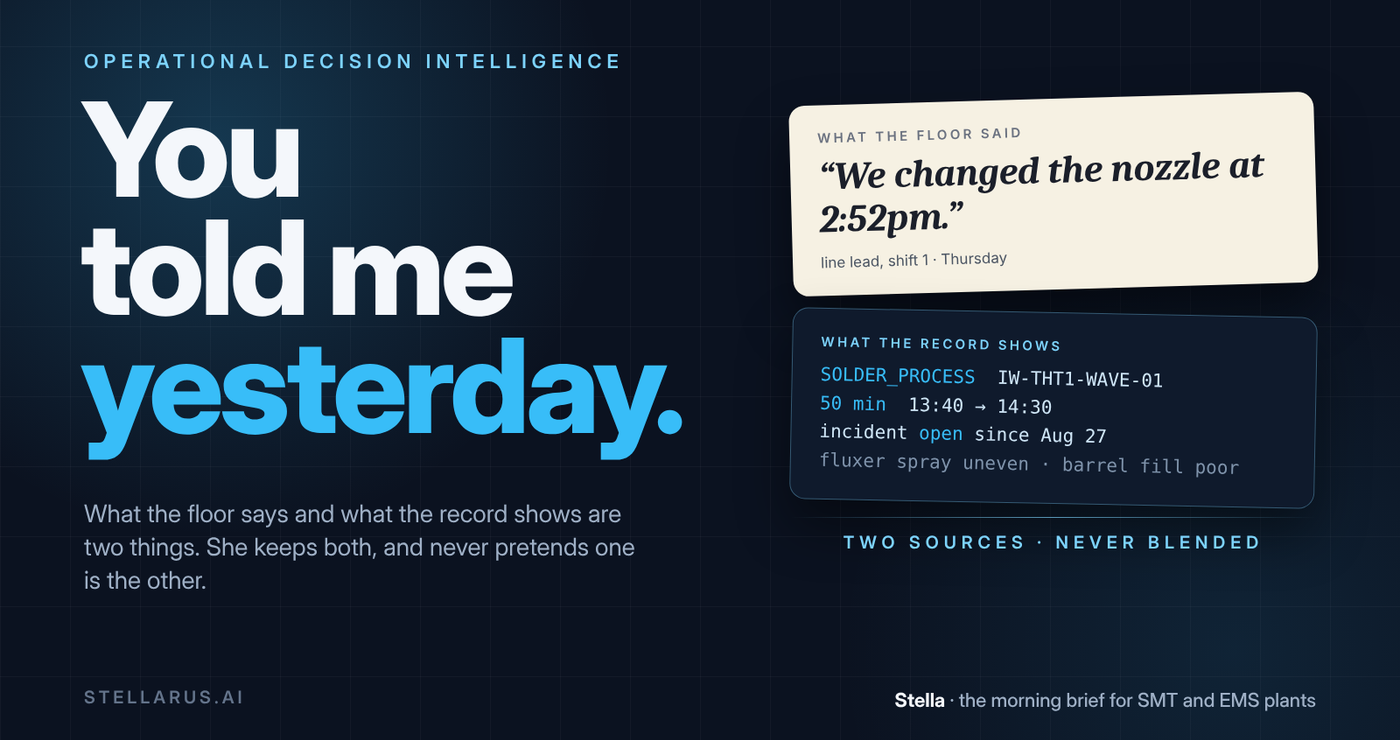
Last Thursday I told Stella something she had no way of knowing. "We changed the nozzle at 2:52pm."
The wave on line one had been throwing solder process stops for six days. The record showed an open incident about uneven flux spray and poor barrel fill. And the thing that actually happened on the floor, somebody pulling the fluxer nozzle at ten to three, was not in any export. It never is.
Friday morning I signed in as a different person, a process engineer, and asked her whether this was the line where we had replaced the nozzle.
She said: "The line lead on shift 1 said yesterday, 'We changed the nozzle at 2:52pm.'" Then she put that next to the incident, said the record still showed it open, and told me the record did not tie the two together.
That sentence is why this post exists.
Every factory tool forgets you
Walk into any plant and look at what the software knows. The MES knows the stops. The quality system knows the defects. Nothing knows that Marco re-tensioned the conveyor belt at the start of second shift, or that the paste was not out of the fridge in time, or that the flux spec changed on Monday. That information lives in people's heads for about a day and then it is gone, and it is usually the one piece that explains the number on the screen.
Two weeks ago I wrote down my own verdict on my own product. She felt like a computer who answered every question as if she never knew who it was. Every morning was the first morning. You could tell her something at nine and she had no idea at ten.
That had to change, and this week it did.
Two sources, never one
Here is the rule that made it work, and it is the same rule that runs the whole product. What the floor tells her and what the record shows are two different things, and she never blends them.
When she uses something you said, she says so. "You told me yesterday the nozzle went in at 2:52pm." When she uses the record, she says that too. "The record shows 50 minutes of solder process downtime on the wave, 13:40 to 14:30." She can hold the two side by side, weigh them, say which one she trusts and why. What she cannot do is take your words and quietly turn them into a fact of her own.
A fact from the floor never changes a number. It never closes a problem. On Thursday I told her we had closed the ICT incident that morning. Her answer: you told me you closed it, the record still shows it open, and what resolved it is not in the record. That is exactly what a good process engineer would say back to me, and it is the opposite of what a chatbot does, which is agree.
Who said it
The second rule is about people, and we got it wrong first.
On your own screen, it is "you told me." On anyone else's, it is "the line lead on shift 1 said," in your exact words, never your name. She never carries a judgment about a person. "The night guys keep bumping the AOI lighting" stays with her and goes nowhere.
The first version drew that line in the wrong place. I told her a changeover had run with one operator, and she refused it as being about people. It is not. Headcount on a job is a fact about the job. We moved the line: names and opinions about people are out, how the work was done is in.
Why this was harder than the morning brief
The morning brief is a speech. The engine decides everything that can be said before she opens her mouth: five figures, one subject, one day, a hundred and fifty words. The gate checks the numbers against a list. Easy to keep honest, because there is nothing left to invent.
A conversation is a conversation. You pick the subject. You mix your words with the record's. You reach across days and across shifts. You ask "did the stop come before the nozzle swap?", which is a calculation. The model that writes her sentences is very good at sounding like it did that calculation and not good at doing it.
So we kept the same rule we have always had: the model writes, it never computes. If she puts two events in order, she has to state both times and both days in the same sentence, and the arithmetic is checked. If she speaks a figure, it is bound to the measure it came from, so a count of boards that failed inspection cannot be spoken as a count of first pass fails. It took a week and a few hundred test conversations to find every place where she was right and got silenced, or wrong and got through.
Where that stands today, in numbers, because I do not think you should take my word for it. In the last full test, forty exchanges across five conversations: zero facts lost, zero names leaked onto someone else's screen, zero quotes altered, and three answers with a wrong number in them. Three is not zero. She is not on anyone's floor until it is.
What it feels like when it works
The best moment of the week was small. I told her, mid-conversation, that poor flux application can cause poor barrel fill. Two questions later she used it, tied it to the incident, and closed with the right check: whether boards through the wave after the nozzle change were showing clean barrel fill at the J3 connector.
She had learned something from the floor and applied it, with the floor's name on it, inside a minute. That is the whole idea. Not a tool that knows everything. A colleague who remembers what you told her, tells you where it came from, and never dresses it up as something it is not.
Stella is the morning brief for SMT and EMS plants. The deterministic-ranking, model-narrated architecture is patent pending.
Subscribe to The Decision Layer
New perspectives on manufacturing and AI, delivered when we publish. No spam.
Unsubscribe anytime.