YOU ALREADY HAVE THE DATA. YOU'RE MISSING THE LAYER.
Walk into almost any plant and you'll hear a version of the same sentence.
"We'd love something like that, but we're not really set up for it. Our data's a mess. We'd have to get our house in order first."
It's said with a kind of resignation, like an admission. And it's almost always wrong.
Not wrong that the data is messy, it usually is. Wrong about what that means. The shop saying it has concluded that the thing standing between them and better mornings is a data problem: more sensors, a cleaner MES, a warehouse, a year of integration work before anyone can help them. So they put it off. The project that never starts because the prerequisite never finishes.
But look at what's already on that floor.
THE DATA IS ALREADY ON THE FLOOR
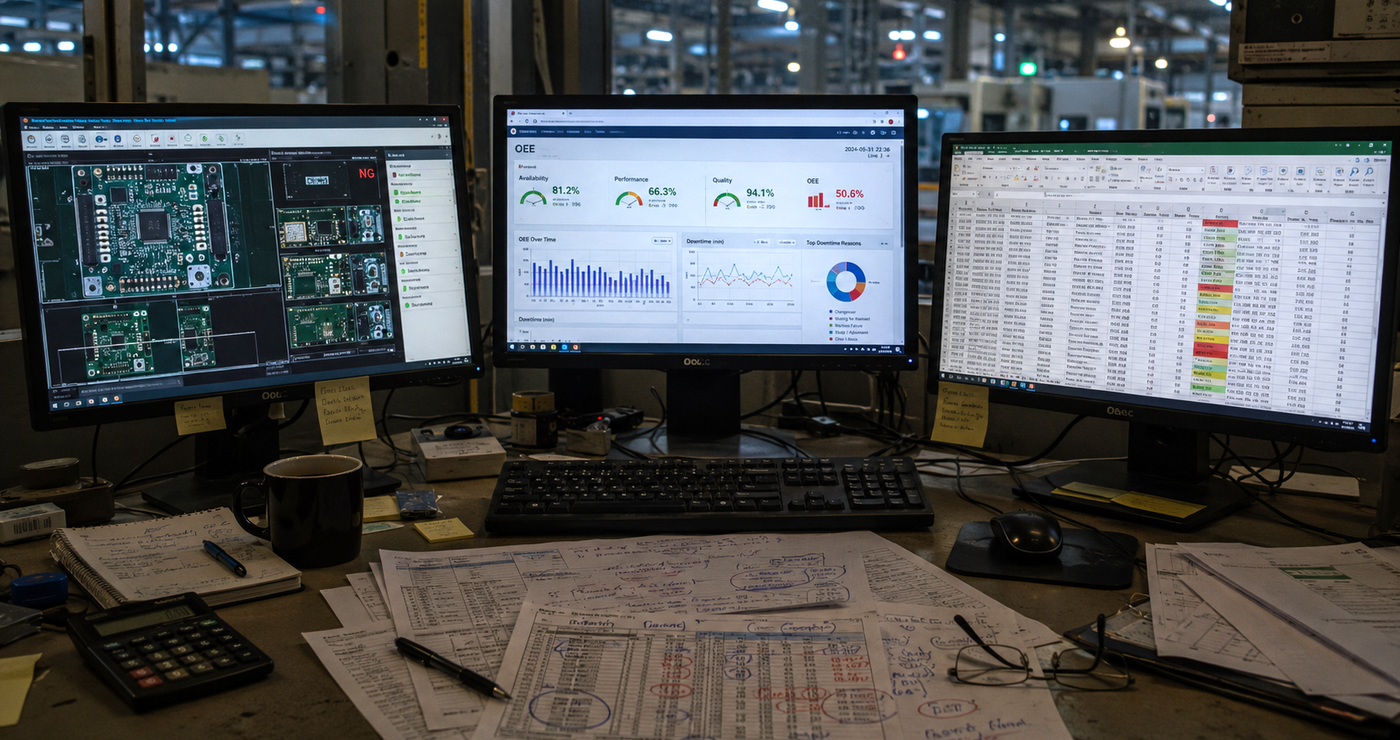
The AOI machine is logging every joint it inspects. The SPI system has paste-volume measurements for every pad. There's OEE by line and shift, downtime events coded by reason, first-pass yield by board, changeover durations, work order history. Most of it exports to a file with a few clicks. Some of it is already sitting in spreadsheets someone built three years ago because the MES wouldn't surface it cleanly.
This is not a data-poor environment. It's the opposite. It's a shop drowning in operational data and starving for decisions.
The mistake is assuming that because the data is scattered, inconsistent, and ugly, it's not usable until it's beautiful that you need one clean system of record before anyone can make sense of it. That's the MES vendor's framing, and it's served the MES vendor well for thirty years. But it isn't true, and it's the single most expensive misunderstanding in the industry. It keeps capable plants waiting on an infrastructure project to solve a problem their existing data could answer Monday morning.
MESSY DATA STILL RANKS
Here's what the "get your house in order first" instinct misses: you don't need clean, unified, real-time data to answer the question that actually matters in the morning. You need enough data to compare today against a baseline and rank what's worth your attention.
A messy export still shows that Line 3's changeover ran long three days running. A spreadsheet still shows first-pass yield dropped after a board revision. An AOI log still reveals a defect signature climbing. The signal is in there. What's missing isn't cleaner data, it's the layer that reads what you have, ranks what rose to the level of your attention, and hands you a short brief with the reasoning attached.
That layer doesn't require ripping out the MES, installing sensors, or spending a year on integration. It requires the data to talk, and the data is already saying plenty. It's just saying it across six systems that don't agree, to nobody in particular, at two in the morning.
THE REAL PREREQUISITE
There is a real prerequisite for fixing the morning problem. It's just not the one people assume.
It isn't more data. It isn't a perfect system of record. It isn't a digital-transformation initiative with a steering committee and an eighteen-month roadmap.
It's a decision to stop treating "our data's a mess" as a reason to wait, and start treating it as the normal condition of a working factory… one the right layer is built to handle as-is.
The plants that win the next decade won't be the ones who spent two years perfecting their data infrastructure before extracting any value from it. They'll be the ones who realized the value was already sitting in the data they had, and went and got it.
You already have the data. What you're missing is the layer that turns it into a decision.
Subscribe to The Decision Layer
New perspectives on manufacturing and AI, delivered when we publish. No spam.
Unsubscribe anytime.