THE MORNING PROBLEM
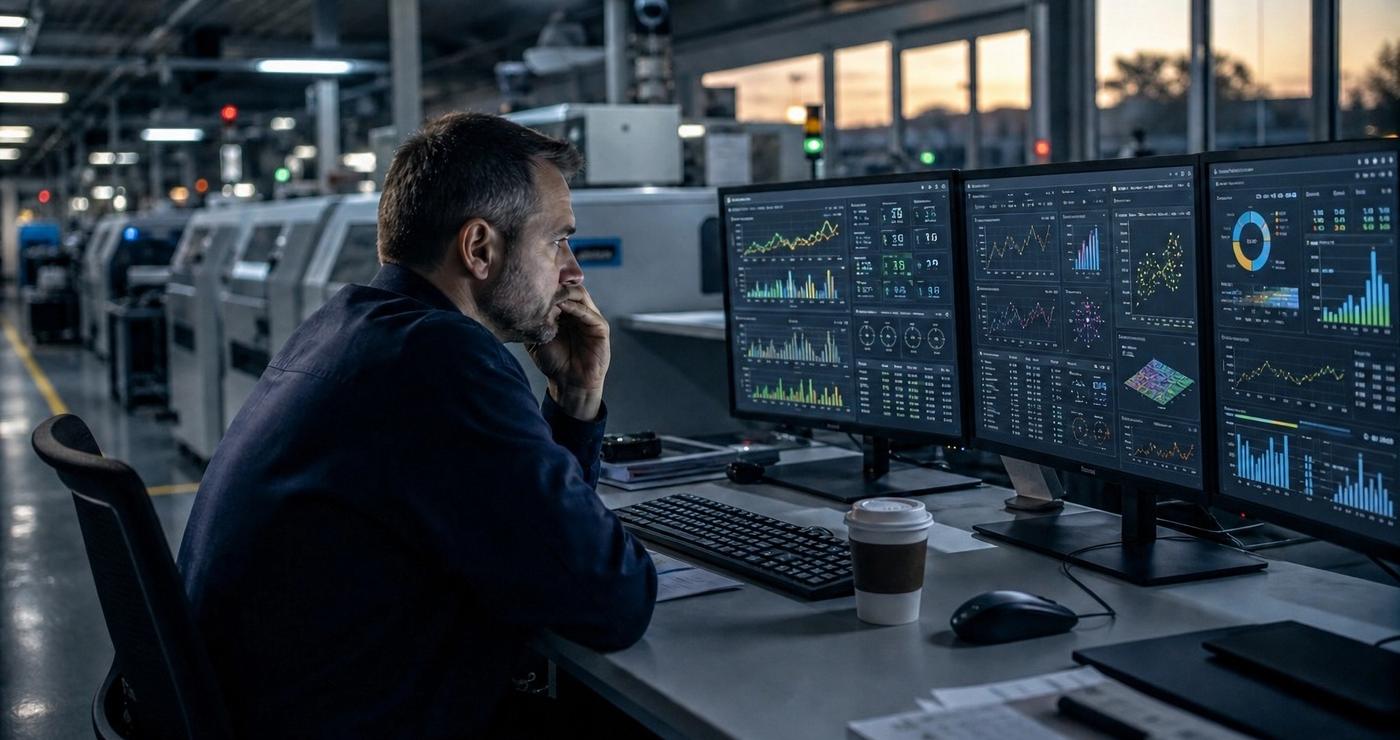
6:47 AM. The shift supervisor walks in, sets down her coffee, and opens the MES dashboard.
OEE: 82.3%. Below baseline.
She pulls up the quality report. First-pass yield on Line 3 is down, and has been since around 2 AM. She opens the spreadsheet someone started three years ago to track what the MES doesn't surface easily. She checks the work order queue.
The day-shift engineers filter in. Someone mentions the changeover on Line 2 ran long last night. Again. Someone asks if it's the board type or the feeder. Nobody is certain.
Forty-five minutes later, they know where to start.
This happens every morning in plants across the industry. I've seen versions of it at nearly every EMS company I've walked through in thirty years on the SMT floor.
A few years ago I was sitting across from a plant manager, showing him our newest analytics product. It could drill into production data, trace issues back through the process, and visualize exactly what was happening at any point in any shift. We'd put real engineering into it. I was proud of it.
I finished the demo. He looked at me, and with a fatigue I could feel from across the table, he said two words.
"Another dashboard."
That was the moment I knew something had to change. Not the software. The question we'd been building software to answer.
THE MAP THAT DOESN'T TELL YOU WHERE TO GO
Manufacturing Execution Systems are remarkable. They capture everything: OEE by shift, by line, by board type. Downtime events coded by category. First-pass yield from AOI. Changeover durations, equipment alarms, work order progress, operator inputs.
The data is there. All of it.
But a dashboard showing OEE at 82.3% tells you there's a gap versus baseline. It doesn't tell you which gap matters most today. It doesn't rank your priorities. It doesn't tell you to start on Line 3, not Line 7, because Line 3's issue is recurring and growing while Line 7's anomaly is a one-time event that will clear itself.
MES tells you what happened. It doesn't tell you what to do.
This isn't a criticism of MES. It's the wrong job for MES. MES is a data capture and execution system, built to record operational reality, not interpret it. Expecting MES to tell you where to focus is like expecting the speedometer to tell you whether to turn left.
Plants have adapted by building human intelligence on top of their systems. Experienced supervisors who can walk a line and sense what's wrong. Veterans who know from the sound of a feeder when something is about to fail. Operators who've learned to read the data through years of pattern recognition.
This works. Until it doesn't.
It doesn't scale. It doesn't transfer. When the supervisor who's been doing this for fifteen years calls in sick, her backup doesn't have her context. It walks out the door when someone retires. It goes home at five o'clock.
The plant manager who said "another dashboard" wasn't frustrated with the technology. He was frustrated with the question. He didn't need a better way to look at the data. He needed something to look at it for him and tell him where to start.
THE MISSING LAYER
For decades, the manufacturing software stack has had a gap.
MES sits at the operational layer, capturing what happens on the floor. ERP sits above it, managing orders, financials, and the business. Between them is everything that matters most to the engineers and supervisors who actually run the plant: situational awareness, priority ranking, and operational guidance.
Nobody built that layer. Not really.
There have been serious attempts — traceability, process analytics, defect root-cause, yield correlation, manufacturing intelligence. I've worked alongside these products. Some of them I've helped sell. They're genuinely capable software built by people who understand the floor.
But what they built — what all of us in that space built — is a better map.
A more detailed, more navigable, more precise map. The kind that answers "why did this happen?" and "where exactly did it break?" The kind the plant manager was already looking at when he said "another dashboard."
The gap was never in the map. It was in the question nobody answered: given everything you know, where should I start today?
THE NEXT LAYER WON'T BE ANOTHER DASHBOARD
There's a name forming for that missing layer: Operational Decision Intelligence. The layer between operational visibility and operational action. It doesn't replace MES, ERP, or analytics. It ranks what matters, explains why, and tells the team where to start — before the first person walks into the morning meeting.
Why is it solvable now, when smart people have been circling it for twenty years? Two things changed.
First, manufacturing systems now produce enough structured operational data to support rigorous baseline comparison, recurrence detection, and priority ranking. The weighted impact of a deviation can be computed — magnitude versus baseline, recurrence pattern, production context, data confidence. That's not estimation. It's math. It's auditable. The ranking can show its work.
Second, language models are now good enough to explain what the math found in plain English — if they're constrained to explain only what the deterministic system already found. Let the AI do the ranking, and you get confident-sounding output that's sometimes wrong in ways you can't audit. That's the failure mode of a lot of "AI in manufacturing" on the market today. The right architecture separates the jobs completely: the deterministic engine ranks, the language model narrates. It can explain. It cannot decide. Hallucination resistance is an architecture choice, not a model choice.
The morning problem is thirty years old. The data to solve it has been sitting in the stack the whole time, waiting for someone to ask the right question — not "what happened?" but "where do I start?"
The next layer of manufacturing software won't be another dashboard.
Subscribe to The Decision Layer
New perspectives on manufacturing and AI, delivered when we publish. No spam.
Unsubscribe anytime.