PROBABLE IS NOT THE SAME AS RIGHT
As you know, I’ve spent many years working with manufacturing companies. Most of that on factory floors, the rest selling the software that runs them. So when the AI wave hit our industry, I did what everyone did. I put a large language model on top of factory data and asked it questions.
It answered every one of them. Confidently. In good English. And about one in ten answers was wrong.
Not wrong in a way you could see. Wrong in a way that sounded exactly like the right ones. Same tone, same certainty, same clean sentence. If you asked ten questions, seven were solid, two were sort of filled in, and one was made up. And you could not tell which was which without going back to the data yourself, which was the thing you were trying to avoid.
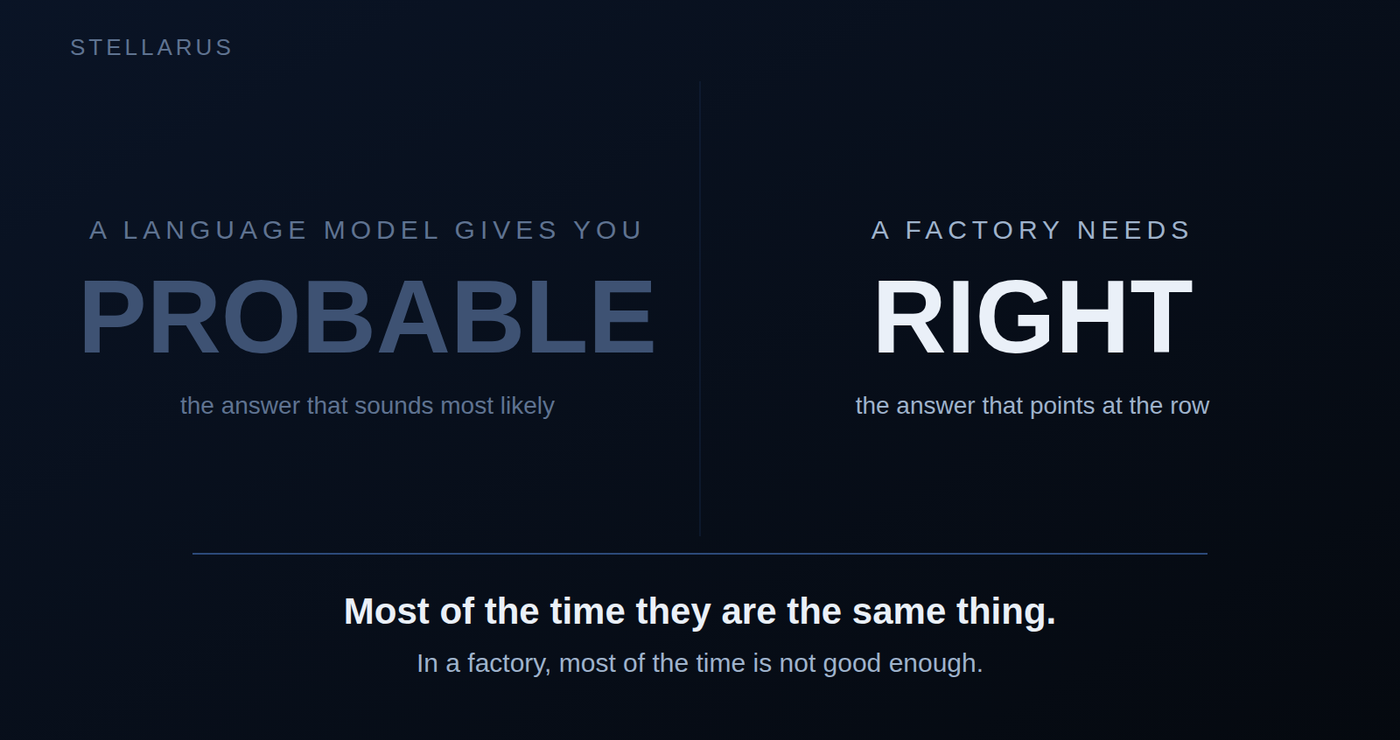
That is not a bug in the model. It is what the model is. A language model gives you the most probable answer. Not the right one. The most probable. Most of the time those are the same thing. In a factory, most of the time is not good enough.
You cannot run a plant on something you cannot audit
Think about what an engineer does with a morning report. He reads that line 4 had a bridging problem, and before he walks over there he asks himself: do I believe this? Where did it come from? If the answer is "the AI said so," he is not walking anywhere. He is opening the raw AOI file and checking, which means the AI saved him nothing.
Trust on a factory floor is earned one specific way. You are right, repeatedly, and when someone checks your work it holds up. A tool that is right 90 percent of the time and cannot tell you which 10 percent it guessed is worse than no tool, because it teaches people to check everything.
So I made a decision early that shaped everything Stella is. The part that decides what matters has to be deterministic. Arithmetic on your own records, against your own baselines, the same answer every time you run it, and every number traceable to the row it came from.
What that looks like in practice
Every night Stella reads the exports a plant already produces. Production counts, downtime, changeovers, SPI and AOI results. She compares every line to its own history. She counts how many days a problem has shown up, how big it is against the baseline, whether it is getting worse. She ranks. All of that is math. No model is involved, and if you ask her how she got a number, she shows you the rows.
Then, and only then, a language model gets involved. Its job is to write the sentences. It gets the ranked result, the figures, and the evidence, and it turns that into something a person wants to read at six in the morning. It is not allowed to add a number that is not in the record. It is not allowed to state a theory as a fact. When it does have a read on something, it has to say so: "my read" is the phrase, and an engineer can correct it.
The model is the writer. It is not the engineer.
Why not just make the model better?
Because the problem is not the model's quality. It is the model's job. A language model is very good at language. It is not a ranking engine, a baseline calculator, or a recurrence counter, and asking it to be one means trusting it on exactly the things it is worst at.
The other way around works. Let the arithmetic decide. Let the model explain. When she is wrong, and she will be sometimes, the wrong part is findable, because every claim points at a row and every read is labeled as one.
The test that matters
Last week an engineer asked Stella why one card said 7 failures and another said 2 defects on the same line, same day. Both numbers were right. One counted boards that failed inspection. The other counted individual bridging calls logged. Different measures of the same morning.
The right answer to that question is not a confident paragraph. It is: here is what the 7 counts, here is what the 2 counts, here is the row each came from, both are correct. She can give that answer because she never guessed either number in the first place.
That is what deterministic means on a factory floor. Not that the tool is never wrong. That when it is, you can find out where, in five minutes, without taking anyone's word for it.
Stella is the morning brief for SMT and EMS plants. The deterministic-ranking, model-narrated architecture is patent pending.
Subscribe to The Decision Layer
New perspectives on manufacturing and AI, delivered when we publish. No spam.
Unsubscribe anytime.